
-
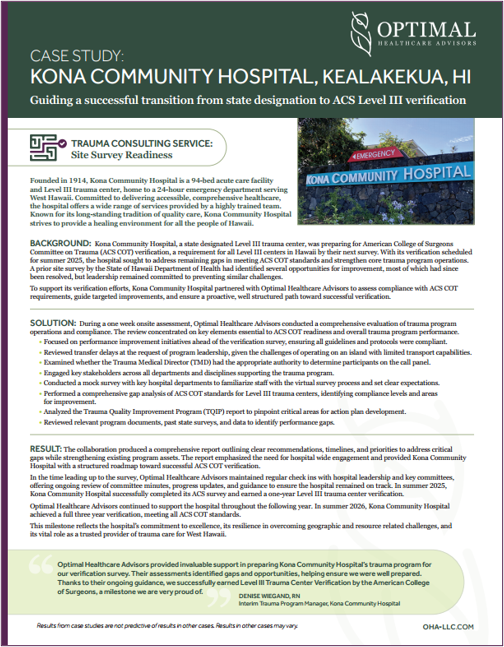
Guiding A Successful Transition From State Designation to ACS Level III Verfication
-
Caring for Behavioral Health Patients in the Emergency Department

-
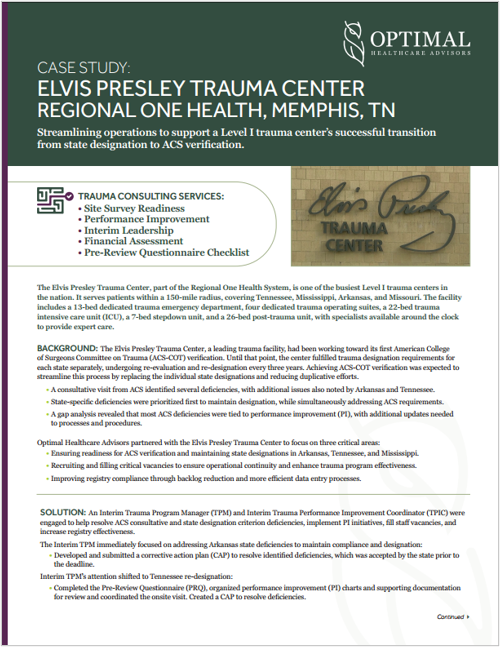
Streamlining operations to support a Level I trauma center’s successful transition from state designation to ACS verification
-
MY01 and Optimal Healthcare Advisors Announce Strategic Partnership

-
A hospital executive’s guide to practical trauma center oversight
-
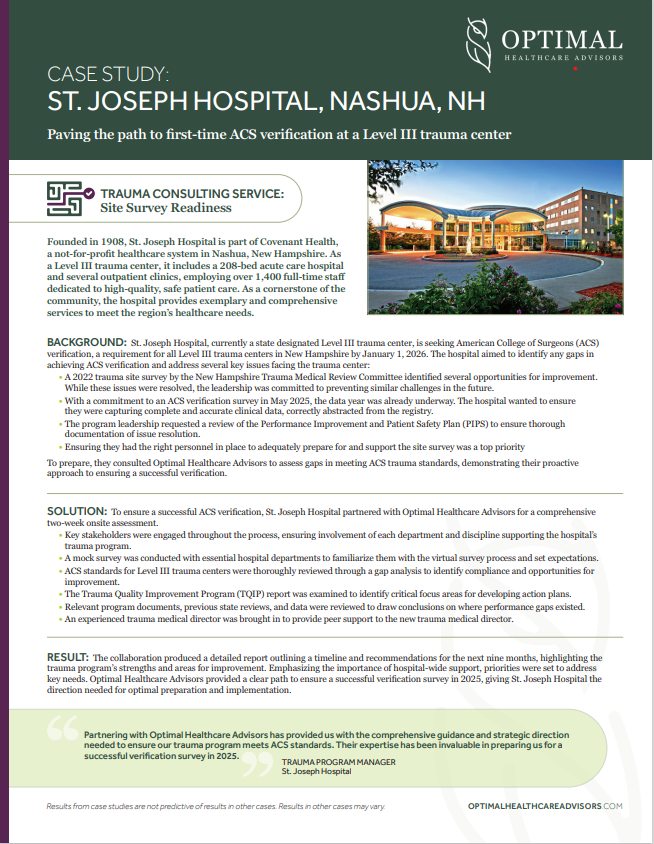
Paving the path to first-time ACS verification at a Level III trauma center
Recent insights
A concise guide to trauma performance dashboards
Angie Chisolm outlines the steps for building a functional trauma PI dashboard and using it to drive effective performance improvement.
Read More 3 strategies for effective loop closure in trauma performance improvement
Theresa Radeker discusses three pivotal strategies that enhance loop closure in trauma performance improvement initiatives.
Read More Guiding a seamless transition from state designation to ACS verification
Explore how Kona Community Hospital partnered with Optimal Healthcare Advisors to ensure readiness for ACS verification.
Read More Stepping into trauma leadership: first steps for new TPMs
Andrea Light offers practical guidance to help new TPMs navigate early responsibilities, build key relationships, and set clear priorities.
Read More OHA broadens portfolio with Trauma Registry Support Services
Discover OHA’s Registry Support Services, offering expert support to implement, streamline, and optimize trauma registry operations.
Read More From overwhelmed to strategic: 10 lessons for new TPMs
Andrea Light shares her insight on the early steps TPMs can take to build relationships, understand program needs, and prioritize work.
Read More How to use PDSA in trauma performance improvement
Angie Chisolm outlines how to use PDSA in trauma PI, showing how the model works when applied in a real clinical setting.
Read More Steering a successful transition from state designation to ACS verification
See how Optimal Healthcare Advisors partnered with a Level I trauma center to prepare for the move from state designation to successful ACS verification.
Read More Trauma PI under pressure: managing staffing gaps and registry challenges
Angie Chisolm shares practical strategies to streamline essential performance improvement work to keep trauma programs on track.
Read More Flawed OIG report on trauma “overpayments” raises key issues
Angie Chisolm and Gretchen Case examine the OIG report findings and what they mean for trauma program leaders.
Read More MY01 and OHA Announce Strategic Partnership
Collaboration between MY01 and Optimal Healthcare Advisors turns real-time data into measurable outcomes for trauma centers.
Read More When to use case review and when to use aggregate review in trauma PI
Angie Chisolm outlines when to use case versus aggregate review in trauma PI to streamline workload and improve patient outcomes.
Read More Why I still talk about the ACS Orange Book
Angie Chisolm explains why the Orange Book still offers valuable insights for trauma PI, especially when mentoring new program leaders.
Read More Complying with ACS Standard 5.11 for Emergency Airway Management
Bill Briggs highlights the importance of a tailored, rehearsed airway plan to support trauma care and meet ACS verification standards.
Read More The critical role of interim trauma leadership in a reporting year
Angie Chisolm shares why interim trauma program leadership is essential for stability, compliance, and performance in a reporting year.
Read More Four steps to comply with pediatric readiness standards
Bill Briggs shares four steps to comply with the pediatric readiness standard ensuring EDs are prepared to care for injured children.
Read More Assessing readiness to meet ACS trauma registry standards
Theresa Radeker explores the critical role the trauma registry plays in achieving and maintaining ACS verification.
Read More Timely orthopaedic response critical for ACS verification
Kristy Ruiz discusses the essential role of prompt orthopaedic intervention in ACS trauma center verification and compliance.
Read More Considering trauma designation for your Emergency Department
Bill Briggs outlines what it takes for an emergency department to achieve trauma center designation and the key advantages.
Read More Minimizing NFS code use to impact mortality outcomes in TQIP reports
Theresa Radeker shares how minimizing NFS code usage and ensuring high-quality data capture improve trauma patient outcomes.
Read More 7 strategies to deepen and enhance your TQIP report analysis
Angie Chisolm offers insight on how going beyond surface-level TQIP analysis is key to uncovering deeper and actionable insights.
Read More Whole blood versus component therapy in trauma resuscitation
Theresa Radeker examines how trauma centers can improve resuscitation outcomes with the right blood replacement approach.
Read More Implementing a trauma data quality plan using ACS Standard 6.1
Angie Chisolm outlines a roadmap to implement a robust data quality plan aligned with American College of Surgeons Standard 6.1.
Read More 5 essential steps for trauma centers to meet SBIRT standards
Theresa Radeker shares 5 key steps for trauma centers to meet SBIRT standards to ensure compliance and improve patient care quality.
Read More Elevating care with Geriatric Emergency Department Accreditation
Bill Briggs highlights the role of Geriatric Emergency Department Accreditation in advancing care for older adults in the ED.
Read More Caring for behavioral health patients in the emergency department
Bill Briggs shares strategies to safely and effectively care for behavioral health patients in the emergency department.
Read More Beyond compliance – nuances and challenges in ACS trauma standards
Angie Chisolm decodes complex ACS trauma standards and provides guidance on demonstrating compliance in a Trauma System News webinar.
Read More 10 key factors to guide your ACS trauma center verification decision
Theresa Radeker outlines 10 factors trauma centers should consider before moving from state designation to ACS verification
Read More Paving the path to ACS verification at a Level III trauma center
Discover how Optimal Healthcare Advisors helped a Level III trauma center prepare for the transition from state designation to ACS verification.
Read More Packaging and assembling rib spreaders for trauma procedures
Angie Chisolm explores methods to ensure team competency and readiness when sterilizing rib spreaders in emergent situations.
Read More Focusing on front end initiatives for ED performance improvement
Bill Briggs highlights the effectiveness of initiating emergency department process improvement projects from the front end.
Read More 5 coding and billing errors that reduce trauma center revenue
Angie Chisolm shares how trauma programs can drive hospital financial performance by optimizing coding and billing.
Read More Appropriately managing trauma patient upgrades and downgrades
Angie Chisolm examines ways to handle upgrades and downgrades during trauma team activations to avoid payment problems.
Read More Bridging healthcare leadership gaps with interim leaders
Bill Briggs explores how interim leadership ensures departmental stability and eases transition to permanent leadership.
Read More A TPM’s guide to mastering their first trauma site survey
Theresa Radeker outlines key steps to help trauma program managers ensure their first trauma site survey is a success.
Read More TQIP requirements for patient care and data quality
Angie Chisolm discusses leveraging TQIP data to drive continuous improvement in patient outcomes and data integrity.
Read More