
Stepping Into Trauma Leadership: First Steps for New TPMs
Andrea Light, MBA, MS, RN, EMT, CEN, TCRN
Senior Advisor
Whether you are stepping into trauma leadership for the first time or joining a new center or program as an experienced leader, the first few months in the Trauma Program Manager (TPM) role are critical. This early period sets the tone for your leadership, your relationships, and the direction of the trauma program. By focusing first on relationships, assessment, and prioritization, you can build a strong foundation for long-term success.
Start with the TPM-TMD Partnership
First and foremost, get to know your Trauma Medical Director (TMD). The TPM-TMD dyad relationship is one of the most important relationships in the trauma program to initiate, develop, and sustain. The TPM and TMD must support one another, stay aligned on strategy and vision, and clearly delineate roles and responsibilities for themselves and the team. Go grab coffee together and learn what makes each other tick. How do you each prefer to communicate? What are your strengths and opportunities for growth, and how can you complement each other? Establish a regular meeting cadence to discuss pertinent issues, pressing needs, and priority to-do items.
Build Relationships Across the System
Speaking of relationships, it is also essential to build connections with your internal and external key stakeholders. Meet-and-greet-style conversations are a practical way to introduce yourself, learn about each stakeholder’s role, and begin discussing how your teams can work together. Internal stakeholders may include the hospital’s executive leadership team, your direct supervisor, department and service line leaders such as the ED, OR, ICU, Radiology, Blood Bank, and Inpatient Nursing, as well as trauma surgeons, liaisons, educators, and others. Spend time with your direct reports, too. Get to know your registry, PI, and injury prevention team members, along with any others who may report to you. External stakeholders may include EMS and prehospital partners, referring facility leadership, regional and state trauma system leadership, and community partners involved in injury prevention or outreach activities. I have even met with my county’s coroner, and he was incredibly welcoming.
Assess, Triage, and Prioritize
At the same time, you will need to triage and prioritize the needs of the trauma program. As Michael Watkins emphasizes in The First 90 Days: Proven Strategies for Getting Up to Speed Faster and Smarter, you cannot tackle everything at once. Instead, assess the program’s actual needs and make informed decisions about which changes should come first. Which issues are “on fire” or “a 911,” such as a regulatory concern or patient safety risk? Which issues are urgent but not emergent? Which can wait? Also consider where your center is in its verification, designation, or accreditation cycle, as an approaching site survey may change how you prioritize your work.
Use a Gap Analysis to Find Your Starting Point
How do you determine the program’s needs? Where do you even start? My favorite tool is a gap analysis. There are many ways to complete one, but I prefer to create a spreadsheet in Microsoft Excel or Google Sheets with a row for each standard my level of trauma center must follow. Refer to the American College of Surgeons (ACS) Verification Review Committee’s (VRC) Resources for Optimal Care of the Injured Patient and/or your state’s designation or accreditation criteria. For example, if you are a Level III trauma center, or seeking to become one, focus on the requirements a Level III center must meet. Then determine whether your center is currently meeting each standard. I like to use stoplight colors—red, yellow, and green—to quickly visualize status. If a standard is not met, identify the action items needed, the responsible people, and the deadline for completion. I use red when a standard is not being met, yellow when it is partially met or in progress, and green when the standard is met.
Focus Your Attention with a Priority Matrix
Once your gap analysis is complete, prioritize the red items first, followed by the yellow. If you have several items in those categories, decide which ones require immediate attention and which can be scheduled for later. A priority matrix
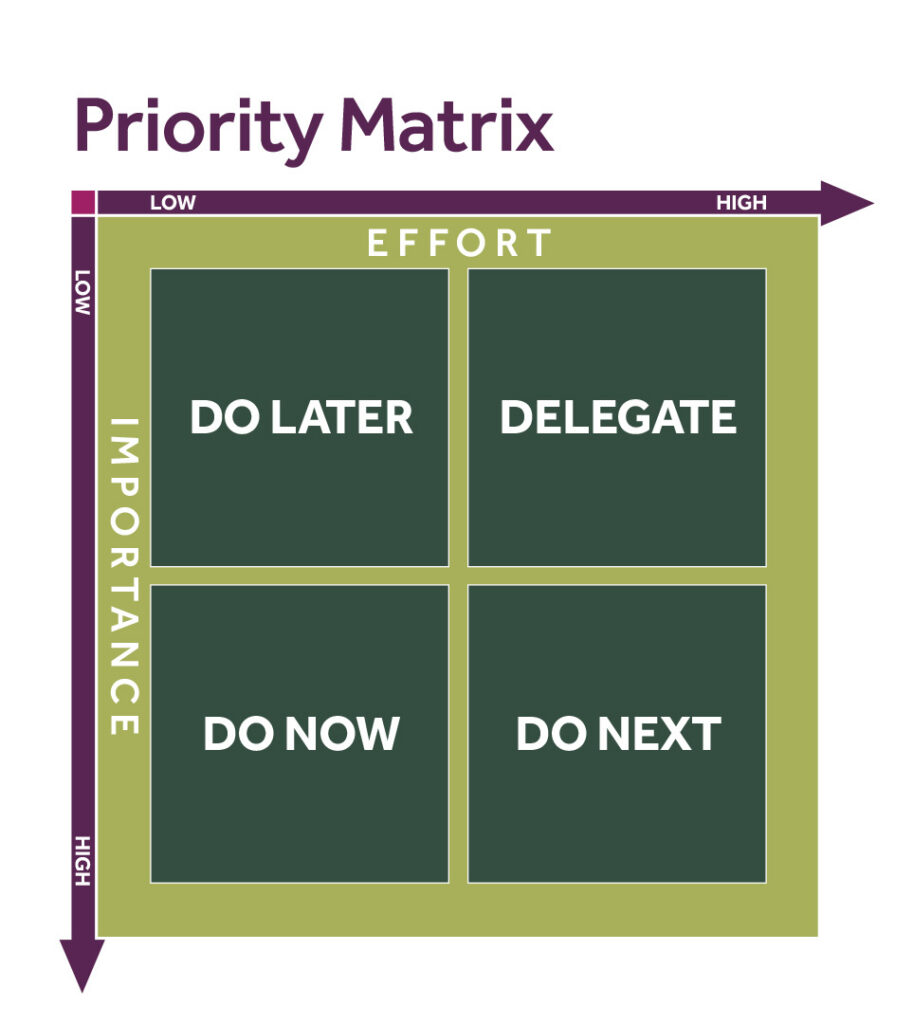
can help focus your attention on the most important and time-sensitive issues. The matrix divides tasks into four quadrants: Do Later, Delegate, Do Now, and Do Next.
Remember: Trauma Is a Team Sport
If you do not already believe this to be true, know that trauma is a team sport. No one person or leader can do it alone. That is why relationships are so important. Once your key stakeholders know you, understand the “why,” and see how their work connects to the trauma program’s goals, they are more likely to partner with you for success. Be purposeful and intentional with your time. There will always be fires, and you could spend your entire day, week, or month focused on them. Stay strategic, focusing your time and energy on the most impactful and necessary issues and tasks.
For new or transitioning Trauma Program Managers, mentorship and external support can make the first months in the role more focused and manageable. Whether through formal mentoring, program assessment, gap analysis support, or leadership coaching, having an experienced partner can help TPMs prioritize effectively, build confidence, and move the trauma program forward with intention.